Friday, July 22, 2022

AJK Assembly resolves to protect territory’s constitutional rights

 Opposition and treasury benches in Azad Jammu and Kashmir (AJK) Assembly on Friday vowed to resist any attempt aimed at divesting the liberated territory and its people of the rights they had gained through a landmark constitutional amendment some four years ago. 

The rare consensus was demonstrated by them during a debate on an adjournment motion by PML-N leader and former AJK premier Raja Farooq Haider, wherein he took strong exception to a recent letter from the Ministry of Kashmir affairs wherein nomination of three representatives from the AJK government was sought for a sub-committee constituted to “examine and finalise the proposed draft of 15th amendment.”

Haider noted that the state of Jammu and Kashmir was a disputed territory whose future status was to be determined by its inhabitants through a UN sponsored plebiscite and it was surprising that the Foreign Office of Pakistan had been ignored in the process, making people feel that the “governments in India and Pakistan had acceded to division of Kashmir under some tacit agreement.”

“The letter has disregarded facts and attempts to undermine the honour of the Legislative Assembly. It has not only hurt the Kashmiris who have always braved India’s machinations but also runs the risk of creating misgivings between the Kashmiris and the government of Pakistan,” he maintained. 

Initiating debate on his motion after the Friday prayers break amid thin attendance on both sides of the divide, Haider recalled that this house had “restored the constitutional, legal, financial and administrative authority of the AJK government in accordance with the spirit of parliamentary democracy and the aspirations of Kashmiris” through the 13th amendment in June 2018.

He expressed his gratitude to Nawaz Sharif and Shahid Khaqan Abbasi for facilitating the approval of 13th amendment. 

Haider, who had brought sundry documents and booklets to quote during his speech, traced the history of AJK’s constitutional evolution right from 1947 amid “unrelenting mischief-making by the Ministry of Kashmir affairs” and said it was why the AJK leadership had agreed to formation of AJK Council during the era of Zulfikar Ali Bhutto.

“However, little did they know that Mr Bhutto will be removed from power after a few years and the Council will become another Chiragh Baig for us,” he said in a reference to a notorious despotic Afghan governor of Kashmir in Mughal rule. 

Declaring himself a nationalist “like all Kashmiris” he wondered why someone had coined the “absurd term of sub-nationalist.”

However, he asked the nationalists that while presenting their viewpoint, they should not lay any blame on the state of Pakistan - the only country on the back of the Kashmiris from day one. 

“Please exercise caution and do not equate Pakistan with India.”

Haider made it clear that as long as AJK remained in existence with the existing special status, the struggle for freedom of the India occupied territory would continue with vigour. 

Without naming anyone, the former premier said someone wanted to take undue benefit of the compulsions of the [PML-N led] central government to get the AJK constitution amended.

“But let me declare this will not happen,” he said, expressing the hope that ruling PTI would also resist the move.

Warning that such attempts were bound to create anti-Pakistan sentiments, the former AJK premier said he was tight-lipped on many issues lest it could create unrest.

Barring few, most of his views were endorsed not only by Sardar Hassan Ibrahim of Jammu Kashmir People’s Party and Bazil Ali Naqvi of Pakistan People’s Party from the opposition benches, but also minister for education Deevan Ali Chughtai, minister for local government Khawaja Farooq Ahmed and some other treasury members. 

“Even though no Pakistani government pursued the Kashmir issue the way we expected, yet we are Pakistanis from beginning to end… Why do you do things that create misgivings about you,” said Ibrahim, urging all parties to rise above political differences and unitedly reject any move against constitutional and financial rights.

Chughtai who spoke on behalf of Prime Minister Sardar Tanveer Ilyas was of the view that neither Prime Minister Shehbaz Sharif nor any other federal government dignitary was behind the move.

“It’s the corrupt officials of the AJK Council who want restoration of previous status.” 

Ahmed assured that the PTI government would not compromise on the constitutional and financial rights of the people. “Rather we will try to acquire more rights.” 

Later, the chair prorogued the session sine die with a note that debate would be resumed whenever the house held the next sitting.  

Tariq Naqash 

Wednesday, June 22, 2022

Kashmiri refugees seek raise in allowance

Representatives of post-1989 migrants from India occupied Kashmir have called upon the prime ministers and parliamentary leaders of Pakistan and Azad Jammu and Kashmir (AJK) to "substantially increase their monthly subsistence allowance to help them make both ends meet."  

The demand, through different letters, was on Wednesday publicly endorsed by Syed Salahuddin, the head of an alliance of indigenous Kashmiris outfits struggling to overthrow Indian occupation. 

According to the official records, 7855 families, comprising 43037 persons, are registered with the AJK rehabilitation department as refugees from across the divide.  

Of them, 3101 families, comprising 17340 persons, are living in 11 camps in Muzaffarabad and Jhelum valley districts, 1159 families, comprising 6766 persons, in five camps in Bagh district and 814 families, comprising 4556 persons, in two camps in Kotli district.

Apart from them, 2781 families, comprising 14375 persons, are living out of camps in different towns.

The government provides a monthly subsistence allowance of Rs 2000 to each of them. Additionally, a monthly stipend ranging from Rs 100 to 300 is given to students from nursery to university students.

However, according to Uzair Ahmed Ghazali and other representatives of refugees, they were finding it next to impossible to make both ends meet in this paltry allowance. 

“Some three decades ago, we left our homes and hearths in occupied Kashmir due to the savagery of the Indian army and have been living ever since in makeshift camps in miserable conditions,” said Mr Ghazali.  

“The sense of deprivation among the refugees is multiplying with each passing day which should be a matter of grave concern for the Kashmiri and Pakistani leadership,” he added.

Mr Ghazali said they had urged Prime Minister Shehbaz Sharif and Prime Minister Sardar Tanveer Ilyas to increase the monthly subsistence allowance by Rs 1500 (taking it to Rs 3500 per person) and were expecting a favourable response from them.

He demanded of the AJK government to allot the two to three marla land of their abodes in different camps to the refugees to help them obtain ‘domicile certificates.’ 

The refugee leader regretted that the 6pc quota of refugees in AJK government jobs was not being fully implemented due to which hundreds of educated youths were unable to secure inductions.

Mr Ghazali said the post 1989 refugees wanted the AJK government to reserve two seats in the Legislative Assembly for them so that their representatives could "put their share in policy making on their rehabilitation as well as the Kashmir freedom movement."

Meanwhile, in a statement, United Jihad Council chief Syed Salahuddin called upon “all people at the helm” to take immediate steps to ameliorate the living conditions of post-1989 migrants. 

“If the salaries of dearness-stricken government officials can be raised considerably, why those terrorised by the Indian army have been ignored,” he said. 

He warned that inaction to address the “grave situation” on a priority basis was bound to leave a negative impact on the freedom movement.” 

Tariq Naqash 

Thursday, May 12, 2022

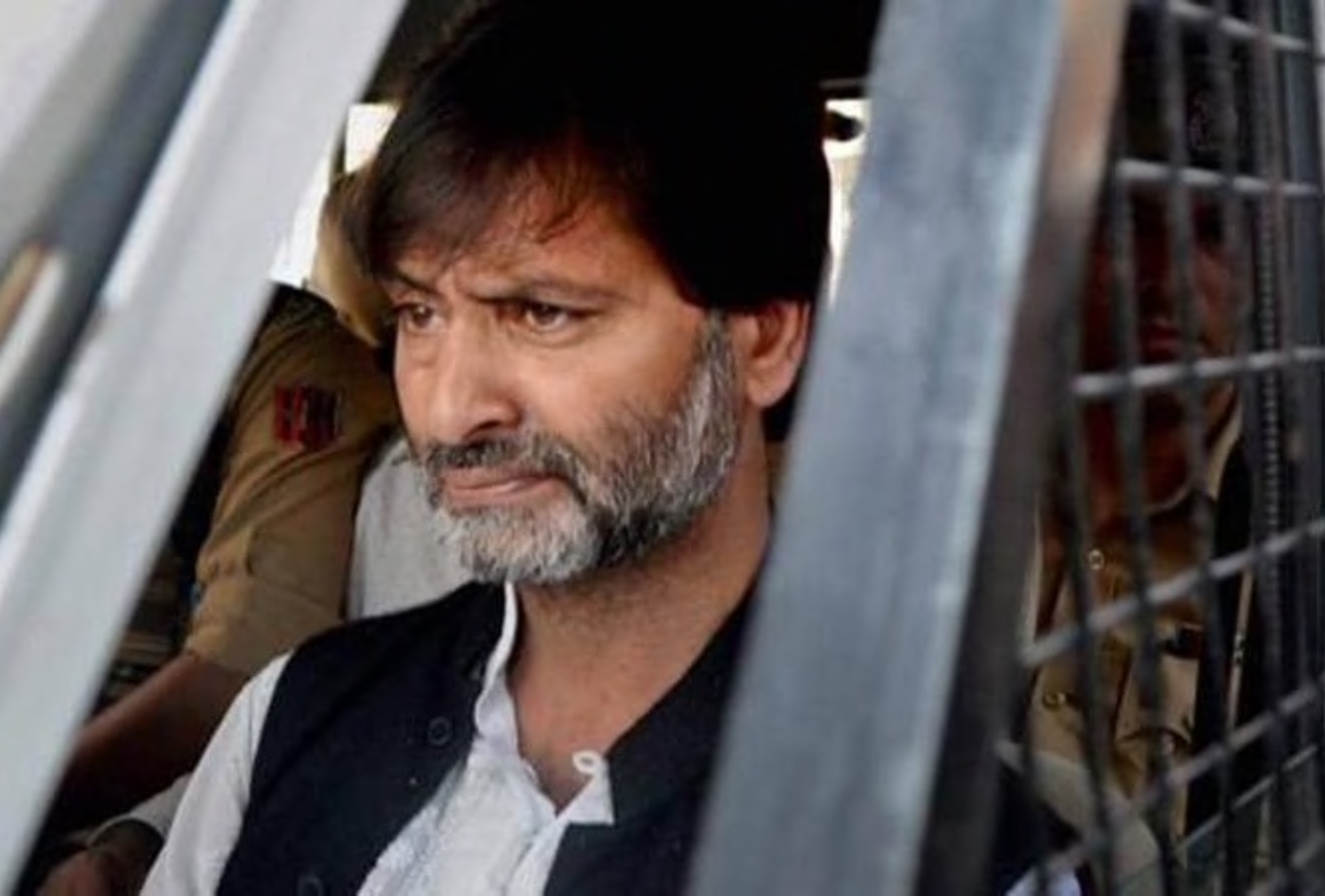
JKLF terms "confession" by Yasin Malik as untrue Indian propaganda

Jammu Kashmir Liberation Front (JKLF) has strongly condemned the Indian act of impleading its incarcerated chairman Muhammad Yasin Malik in a concocted, fabricated and politically motivated case of terrorism filed by India’s notorious National Investigation Agency (NIA) in a New Delhi court.

“This act is immoral, illegal and reflection of political vendetta against the JKLF chief and has been done on the dictates of India’s [Narendra] Modi led Hindutva regime to silence a popular and the most powerful voice of people’s right for independence of the internationally disputed State of Jammu Kashmir,” said Malik’s special representative and JKLF chief spokesperson Rafiq Dar in a statement.

He also refuted reports in Indian media about his alleged confession of charges and termed it as “untrue and malicious and one-sided.”

Dar noted that ever since Malik’s arrest on February 22, 2019 and particularly after his transfer to New Delhi’s infamous Tihar Jail on May 10, 2019, he had decided not to contest these fabricated cases and had withdrawn his defence lawyer in protest after observing and anticipating the unfair and biased court proceedings and the ill intentions of the Indian government. 

The JKLF chief, he said, had always refuted and rubbished the charges of terrorism and terror funding levelled against him by infamous NIA and had been terming the court process arbitrary and an act of political victimization.

The court had turned down Malik’s repeated demands for a fair trial apart from asking it to look into the history of JKLF and his role in the promotion of religious harmony, nonviolence and peaceful settlement of Kashmir conflict, but to no avail, he added.

On May 10, during the course of hearing, Malik once again repeated the same argument and asked the judge that if his demand for freedom was a crime then he was ready to face the consequences.

 Thereby, terming his demand for freedom as a “confession of the charges” levelled in the concocted cases against him, the judge illegally and unfairly pleaded him guilty, Dar said.

He pointed out that for the last three years Malik had been languishing in solitary confinement in Tihar Jail and was out of contact even with his immediate family. 

“So, such stories coming out from the Indian side, like his confession of charges levelled in the concocted cases against him, are untrue, malicious, one sided and biased.”

The spokesman also condemned “all those propagandists who at the behest of Indian agencies were busy in maligning Malik on social media” and asked the Kashmiri people not to fall prey to false propaganda by India and its well-known stooges living in and outside the disputed Himalayan region.

“The Kashmiri nation living from across the ceasefire line have already rejected these stooges as they are the paid agents of Indian agencies working for India and against our freedom movement,” Dar said, without naming anyone. 

Meanwhile, separately, Azad Jammu and Kashmir (AJK) Prime Minister Sardar Tanveer Ilyas has also strongly condemned the unilateral trial by India’s special court against the prominent pro-freedom leader Yasin Malik, terming it immoral and unjustified.

He said Malik had spent his entire life in the resistance movement against India’s occupation forces and he was being subjected to political vengeance and religious hatred in India.

“Yasin Malik is a political prisoner, a liberation [movement] leader who has been peacefully championing the Kashmiris’ just cause of freedom the way Mahatma Gandhi and Nehru fought against the British rule,” he said.

Calling for a befitting response to counter Indian media’s negative propaganda the AJK premier asked the social media activists on this side of the Line of Control should refrain from “copy and paste” practice of the news run by the Indian media. 

“Copy-pasting Indian version of the news on social media is tantamount to becoming the part of the Indian propaganda campaign,” he said. 

Ilyas vowed that he would raise this issue with other political stakeholders including the Hurriyat Conference and other international organizations working for human rights.

Naming several prominent Kashmiri detainees, he said India’s apartheid regime wanted to silence all political leaders, civil society and human rights activists and media persons by keeping them in jails for longer durations.

He called upon the Kashmiri diaspora to mobilize the US Congress, the British and European parliaments and the UN Human Rights Council on this issue.

Tariq Naqash


Sunday, May 8, 2022

JKLF regrets Pakistan's "failure to engage UN after India's Aug 5, 2019 move"

Jammu Kashmir Liberation Front (JKLF), an organisation advocating reunification and complete independence of the divided state of Jammu and Kashmir, on Saturday called upon Islamabad to have a “serious review” of its policy on the disputed Himalayan region in the wake of India’s unilateral August 5, 2019 move.

“Pakistan should formally rescind the Simla Accord of 1972 with India to free itself as well as the Kashmiris from the futility of bilateralism and take the issue of Kashmir to the United Nations Security Council (UNSC),” said the JKLF in an ‘open letter’ to Prime Minister Shehbaz Sharif, a copy of which was also emailed to Dawn. 

Pakistan’s failure to engage with the UN has enabled India to continue her aggression against the Kashmiris, maintained the organisation in the more than 2200 words letter, signed by its acting chairman Raja Muhammed Haq Nawaz Khan.

The JKLF asserted that the “lack of meaningful political and diplomatic measures on the part of Pakistan” to counter India’s illegal unilateral action of August 5, 2019 had subsequently intensified “serious apprehensions among the Kashmiris about Pakistan’s Kashmir policy, and policy on the status of Azad Jammu and Kashmir (AJK) and Gilgit-Baltistan (GB).”

“For almost 75 years, the Kashmiris have come to expect Pakistan’s ardent support for their right to freely decide on the status of their internationally disputed homeland. There is a painful realization, especially since August 2019, that Pakistan's stated policy of support for the struggle and territorial integrity of Kashmir within the UN Charter and relevant UNSC resolutions has changed.”

 The JKLF maintained that India’s August 5, 2019 move was a fundamental departure from the historic context of the issue which required a “robust political and diplomatic response” from Pakistan. "But Islamabad’s response can hardly be considered appropriate, let alone robust." 

“Far from having to explain her aggression against Kashmir to the UNSC, the Indian government has been emboldened, despite having defied the UN resolutions 38, 91, and 122 with Kashmir’s annexation,” it added.

While urging Islamabad “not to proceed with its policy of absorbing either GB or AJK into its federation or extending AJK’s representation in the National Assembly,” it went on to demand the repeal and dissolution of the Karachi Agreement of April 28, 1949, whereby the administrative control of GB was handed over by the AJK government to the government of Pakistan.

Islamabad should instead support the formation of a democratically elected and fully empowered national revolutionary representative government of AJK and GB as one political entity, with an “Independent Joint Council” (IJC) representing both the regions, as its upper house, it suggested.

It also called upon Islamabad to enter into a “constructive dialogue” with the Kashmiri leadership on the existing policy as well as the one warranted by the situation in the wake of India’s actions on and after August 5, 2019. 

 Elaborating its ICJ formation proposal, the JKLF said that Islamabad should allow both AJK and GB to have their separate democratically elected assemblies and fully empowered governments and let them form the IJC comprising members appointed by both governments. 

The IJC would not only act as a constitutional bridge between the people of AJK and GB but would also ensure a formal relationship with the government and the state of Pakistan within the framework of the UNCIP resolutions as well as the mutual interests of both sides, it added.

The JKLF also urged Islamabad to enable the current governments in Muzaffarabad and Gilgit to formally open a dialogue between them with reference to its recommendations, with participation in the process from the parties that had no representation in either of the assemblies.

Tariq Naqash 

Tuesday, April 19, 2022

PROFILE: From business affairs to state affairs

In the last week of February 2021, Sardar Tanveer Ilyas made his first public appearance in the political arena of Azad Jammu and Kashmir (AJK) at a rally in Rawalakot where he vowed among other things to snowball the popularity of Pakistan Tehreek-e-Insaf (PTI) to help it singlehandedly form the next government in the territory. And over the next one and a half years, he literally moved heaven and earth to translate his avowal by bringing many electables in the party’s folds at the strength of his personal relations and resources. When the party clinched victory, neither he nor any of the other probables were considered by PTI chairman Imran Khan for the coveted position of the AJK premier. Instead, Khan chose a minnow to the surprise rather shock of the entire parliamentary party which somehow resigned itself to his decision. Only 14 months after his first political engagement in AJK and nine months after the general elections, Lady Luck eventually smiled on Ilyas and he took the oath as 14th prime minister of the liberated territory on April 18 (Monday). 

Ilyas was born in 1974 to Sardar Ilyas Khan, the eldest of the seven sons of Sardar Muhammad Sharif of Bungoin village of Poonch district. His grandfather, a well-off landholder of his area, had also returned as a Basic Democracy member in the early sixties. Ilyas’ father went to Saudi Arabia at a young age to try his luck there and eventually rose from an ordinary position to the president of al-Tamimi group – a conglomerate of companies doing businesses in around nine sectors with over 25000 employees, almost 40 percent of them from Pakistan and AJK. Those who know Khan, who was awarded with Sitara-e-Pakistan in 2019 for his feats, say sedulousness, incorruptibility, loyalty and business wisdom helped him climb to the highest of positions in the business community. His personality traits have passed on to his three sons - Ilyas being the eldest one – which is why they set up their Sardar Group of Companies in Pakistan which has built among other things the wonderful shopping mall in the heart of Islamabad by the name of Centaurus. 

Huge business ventures notwithstanding, the family never severed its connection with politics. Sardar Saghir Chughtai, one of the paternal uncles of Tanveer Ilyas, became the AJK Council member in 2011 for five years. In 2016, Mr Chughtai contested Legislative Assembly elections from their native constituency on the ticket of Muslim Conference and became the MLA. Shortly before 2021 polls, Mr Chughtai who had also joined PTI at the persuasion of his nephew died in a tragic road accident in the territorial limits of Rawalpindi. Such was his popularity in the constituency that people returned his widow Shahida Saghir in the 2021 elections.  Ilyas grabbed electoral victory from the neighbouring Bagh district. Having earned business administration, law and journalism degrees before and during the management of family’s businesses, he was friends with prominent personalities of different walks of life, such as politicians, civil and military bureaucracy and media. In 2009, PML-Q leadership with whom he enjoyed a close personal relationship had got him nominated for a Senate seat even though he was not a member of their party. But he did not take part in the election due to the political uncertainty in the country. Ahead of the 2018 elections, he was appointed as a caretaker minister in the provincial Punjab government. He joined the PTI soon after the 2018 election and was made chairman Punjab Board of Investment and Trade in January 2019. Impressed by his entrepreneurial skills, Imran Khan asked the then Punjab chief minister Usman Buzdar to appoint Ilyas as his special assistant for investment related affairs. However, Khan wanted to test his abilities in AJK where the PTI had bagged just 2 seats in 2016 elections to the AJK Assembly. 2021 was the election year in AJK and while the PTI was gearing up to forcefully contest the polls, Khan tasked Ilyas to manipulate his strong tribal and personal connections in the territory to help the party “vanquish its political rivals” there. Sardar Murtaza, a confidant of Ilyas, asserts that his enthusiastic involvement in election campaign turned out a boon for the party, as he spared no effort to boost the morale of the activists and candidates across the territory as well as in the constituencies of Pakistan based Kashmiri refugees. "Resultantly the PTI emerged as a single largest party in the Assembly." Now when Ilyas is in the driving seat in AJK, Yasir Arif, an Islamabad based analyst, believes that he will exercise his expertise to bring a paradigm shift in this territory blessed with huge potential for skyrocketing progress but "devoid of visionary leadership." “The way he has raised his business empire in a short time, he surely will also raise the economic profile of AJK before long,” he claims. 

On Monday, when Ilyas was delivering his victory speech in the Assembly, in the Visitors’ Gallery were seated four generations of his family – his grandfather, parents, spouse and children - all with beaming faces. The dream had come true ahead of time, but together with the daunting challenge of ‘skilful management of state affairs’ from the successful management of business affairs. 


Tariq Naqash


Thursday, March 3, 2022

Abdul Majeed Mallick laid to rest in Mirpur

Former Chief Justice of the Azad Jammu and Kashmir (AJK) High Court and former president of Jammu and Kashmir Liberation League (JKLL) Abdul Majeed Mallick was laid to rest in the lakeside city of Mirpur on Wednesday.

Earlier, his funerals were attended by a large number of legal fraternity members, political workers and civil society activists, including AJK Prime Minister Sardar Abdul Qayyum Niazi and three of his predecessors, in the town's Quaid-e-Azam Stadium. 

A condolence reference was also held on the occasion, where speakers from different walks of life paid glowing tributes to the veteran leader for his qualities and contribution to the society as a celebrated jurist and a farsighted political leader. 

Terming Mr Mallick as an institution in himself, they said his unblemished character and commitment to cause will continue to offer guidance to the youngsters aspiring to join legal profession or politics. 

“Justice Abdul Majeed Mallick was an esteemed jurist and an insightful politician enjoying complete grip on all aspects of the longstanding issue of Jammu and Kashmir,” observed PM Niazi in his speech. 

He maintained that while as a judge Mr Mallick had delivered par excellence judgments in accordance with the law and constitution, as a devoted political figure he had religiously pursued his mission to ensure true democracy and good governance in AJK and freedom of occupied Kashmir.

“His services for the supremacy of law and justice as well as for the emancipation of our oppressed brethren across the divide will be remembered for long times to come,” Mr Niazi added.  

Others who spoke at the condolence reference were former prime ministers Chaudhry Abdul Majeed and Haji Yaqoob Khan, PPP regional president Chaudhry Muhammad Yasin, minister for local government and rural development Khawaja Farooq Ahmed, supreme court CJ Raja Saeed Akram, high court CJ Sadaqat Hussain Raja, former apex court CJs Azam Khan and Syed Manzoor Hussain Gillani, Manzoor Qadir of JKLL, Rafiq Dar of JKLF, Mahmood Saghar of APHC and former JIAJK chief Abdul Rashid Turabi in addition to several representatives and office bearers of different bodies of lawyers. 

Muslim Conference supreme leader Sardar Attique Ahmed Khan, who was among the attendees, however declined to speak on the occasion, saying his time should be given to some other speaker. 

The AJK government had declared a holiday in all three districts of Mirpur division to allow 

Tariq Naqash


Wednesday, March 2, 2022

Former JKLL chief Abdul Majeed Mallick passes away


Azad Jammu and Kashmir (AJK) lost an eminent jurist and an intellectual in politics as retired justice Abdul Majeed Mallick bade adieu to this mortal world on Tuesday, plunging his family, friends and followers on both sides of the divide into gloom. 

Mr Mallick, who was 89 and a half years old, had been hospitalized in District Headquarters Hospital Mirpur about two weeks ago due to acute chest infection. Some four days ago, his family had brought him back home where he breathed his last at about 3pm.  

Born on September 15, 1932 in a suburban village of Dadyal, Mr Mallick chose a career in law and earned his LLB degree from Lahore. From 1956 to 1958, he practised law in Lahore but returned to Mirpur due to family’s relocation in the wake of Mangla Dam's construction.

In AJK, he was enthusiastically associated with the visionary Kashmiri leader Khurshid Hassan Khurshid aka K H Khurshid from a young age.

When Mr Khurshid launched his Jammu Kashmir Liberation League (JKLL) party in 1962, Mr Mallick was appointed its founding chief organizer. He became the party's secretary general in 1967 and held this position over the next 11 years. 

Since he was also an eminent practicing lawyer, he was inducted in the AJK High Court as a judge in May 1978 where he became the chief justice in August 1983, an office he held until his retirement in September 1994 on attaining the age of superannuation. 

As most of the JKLL workers would view him as the mirror image of Mr Khurshid, Mr Mallick took the reins of the party on their insistence from 1996 to 2020. 

From 2005 to 2010, Mr Mallick undertook around 10 visits to India and separately another four to India occupied Kashmir through Wagah border under track-II diplomacy and people-to-people contact initiatives. During these visits, he had addressed many events and met many important personalities. 

It was why social media was flooded with condolence messages from the Kashmiris not only from both sides of Jammu and Kashmir but also from UK, Europe, USA and Canada. 

“So sad to hear about him. May he rest in peace. My heartfelt condolences to his family,” tweeted Nayeema Ahmed Mehjoor, an author, broadcaster and journalist from Srinagar, currently living with children in London. 

Syed Nazir Gillani, chairman of the London based Jammu Kashmir Council for Human Rights, said that in the death of Mr Mallick the state of Jammu and Kashmir had lost a great son.  

“We have lost an unfailing and reliable friend. A courageous person and carried an overwhelming influence. A day of mourning. Allah bless his soul in heaven,” he tweeted.

On Facebook, former ambassador Arif Kamal wrote: “We lost a gem of the unfragmented state of Jammu-Kashmir. The man who held high the flag of our national emancipation.”

Apart from almost all heads of the AJK political parties and cabinet members, sitting and former judges of the AJK’s superior judiciary and legal fraternity members also paid glowing tributes to Mr Mallick for his services in the fields of law and politics. 

A fearless jurist who stood firm in his rulings and conviction had many bold judgments to his credit. 

In March 1993, he had taken everyone by shock when he held that Gilgit-Baltistan (GB), then referred to as Northern Areas, were part of the erstwhile princely state of Jammu and Kashmir. In the landmark judgment, he had directed the central government to hand over GB’s administrative control to the AJK government. He directed the AJK government to take over control and give equal rights and representation to the GB people in all institutions of the state and establish the same institutions in GB. However, the judgement was not upheld by the apex court on the point of jurisdiction. 

“… his decisions in law books will keep him alive forever and his services for the judicial system will be a guideline for us… Historians will jot down your efforts for Kashmir cause in golden words,” said Syed Zulqarnain Raza Naqvi, an office bearer of the AJK High Court Bar Association. 

In order to pay him respects, the chief justices of AJK’s supreme and high courts announced suspension of judicial work in their respective courts on Wednesday while the AJK government declared a holiday on Wednesday in three districts of Mirpur division to facilitate the people to attend his funerals. 

Until early this year, Mr Mallick enjoyed good health with a surprisingly good memory and led an active life in the lakeside city of Mirpur, receiving visitors at his residence and attending events outside with regard to Kashmir issue.

In December last year, he launched his autobiography. On that occasion, he told this scribe that he had put together his personal observations and experiences which also included some controversies that had not come into the open to this day.

“I believe that a writer should be fair to his readers and set the record straight without bothering about the response,” he had said.


Tariq Naqash